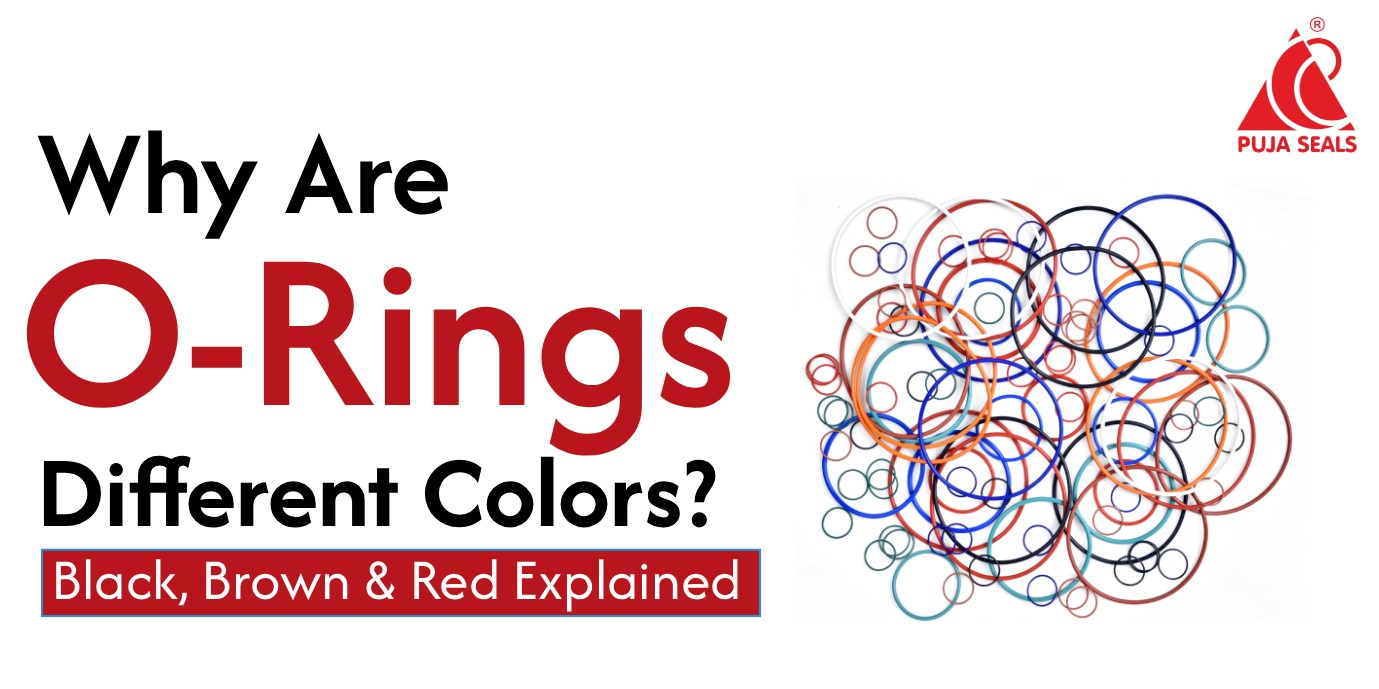
When choosing sealing products, color is often one of the first things people notice. Black, brown, red, green, and other colors are commonly seen in industrial sealing applications. But does the color of a seal tell you something about its performance?
In many cases, it can provide a quick way to identify a material, compound, application, or manufacturer specification. However, color alone should never be used to select a seal. Material composition, temperature range, chemical compatibility, pressure, and application conditions are much more important.
At Puja Seals, we understand that selecting the right sealing solution requires attention to both product specifications and operating conditions.
What Are O-Rings?
O-Rings are circular sealing components designed to prevent fluids or gases from passing through a connection. Their simple shape allows them to be used in a wide range of industrial equipment.
They are commonly found in:
- Hydraulic systems
- Pneumatic equipment
- Pumps and valves
- Automotive components
- Industrial machinery
- Chemical processing equipment
- Fluid handling systems
The material used to manufacture an O-ring determines many of its properties, including resistance to heat, chemicals, oils, pressure, and environmental conditions.
Why Do O-Rings Have Different Colors?
There is no universal rule that says one specific color always represents one specific material. Manufacturers may use different colors for identification, branding, compound differentiation, or application-specific requirements.
Therefore, color should be treated as an identification aid rather than a technical specification.
Black O-Rings
Black is one of the most commonly seen colors in industrial sealing applications. Many black seals are made from materials such as nitrile rubber, EPDM, or other elastomer compounds.
Black is often preferred because it provides a consistent appearance and can work well in demanding industrial environments.
However, two black seals can have completely different material compositions and performance characteristics.
Brown O-Rings
Brown-colored seals are also used in various industrial applications. The color may be associated with certain material compounds or manufacturer-specific identification systems.
Depending on the compound, brown seals may be designed for particular temperature, chemical, or fluid exposure conditions.
It is important to check the product specification instead of assuming performance based only on color.
Red O-Rings
Red seals are commonly used where manufacturers want easy visual identification. In some applications, red may be associated with specific high-temperature or specialized elastomer compounds.
However, red does not automatically indicate that a seal is suitable for high temperatures or a particular chemical.
The actual material grade and operating specifications should always be verified before installation.
Does Color Determine O-Ring Performance?
Not necessarily.
The performance of a seal depends on factors such as:
- Elastomer material
- Temperature range
- Pressure
- Chemical exposure
- Fluid compatibility
- Shaft or groove dimensions
- Compression
- Operating speed
- Environmental conditions
Two seals with different colors may perform similarly, while two seals with the same color may have completely different properties.
How to Select the Right O-Ring
Instead of choosing a seal based on appearance, start by understanding the application.
- Identify the Fluid: Determine whether the seal will come into contact with oil, water, fuel, chemicals, air, or another medium.
- Check Temperature:Know the minimum and maximum operating temperatures. Extreme temperatures can affect elastomer flexibility and sealing performance.
- Consider Pressure: The seal must be suitable for the system pressure. High-pressure applications may require specific materials and designs.
- Confirm Dimensions: Correct inside diameter, cross-section, groove dimensions, and compression are essential for proper sealing.
- Check Material Compatibility:Choose an elastomer that can withstand the specific operating environment
Why Work With Experienced Manufacturers?
Reliable o ring manufacturers can help customers identify the appropriate material and specification for a particular application.
At Puja Seals, we focus on providing sealing solutions based on application requirements rather than relying only on visual identification.
Our approach considers factors such as material compatibility, operating temperature, pressure, dimensions, and expected service conditions.
Common Mistakes to Avoid
- Choosing Only by Color: Color is not a reliable substitute for material specifications
- Check Temperature: Know the minimum and maximum operating temperatures. Extreme temperatures can affect elastomer flexibility and sealing performance.
- Ignoring Temperature: A seal that works well at room temperature may not perform properly at extreme temperatures.
- Using the Wrong Size: Incorrect dimensions can lead to leakage, extrusion, or premature wear.
- Overlooking Chemical Compatibility: Exposure to incompatible fluids can cause swelling, hardening, cracking, or loss of elasticity.
Why Choose Puja Seals?
At Puja Seals, we understand that dependable sealing is essential for industrial equipment performance.
We focus on:
- Quality sealing products
- Application-focused solutions
- Consistent manufacturing
- Material selection guidance
- Industrial sealing expertise
- Reliable customer support
Our goal is to help customers choose sealing products that match their actual operating requirements.
Conclusion
The color of O-Rings can sometimes help with identification, but it should never be the only factor used when selecting a seal. Black, brown, and red products can represent different compounds, manufacturer identification systems, or application requirements.
For dependable sealing performance, always check the material, dimensions, temperature range, pressure rating, and chemical compatibility.
By working with experienced o ring manufacturers and selecting products according to the application, businesses can reduce leakage, improve equipment reliability, and extend seal service life.
Frequently Asked Questions (FAQs)
Not always. Color can be used for identification, but there is no universal color-to-material standard. Always check the product specification.
No. Performance depends on the material compound and application requirements rather than color alone.
Check the material, size, temperature range, pressure requirements, fluid compatibility, and operating environment.
Yes. An incompatible material may swell, harden, crack, or lose its sealing properties when exposed to unsuitable fluids or temperatures.
Evaluate the operating conditions and consult a sealing specialist or manufacturer to select the appropriate material, size, and specification.