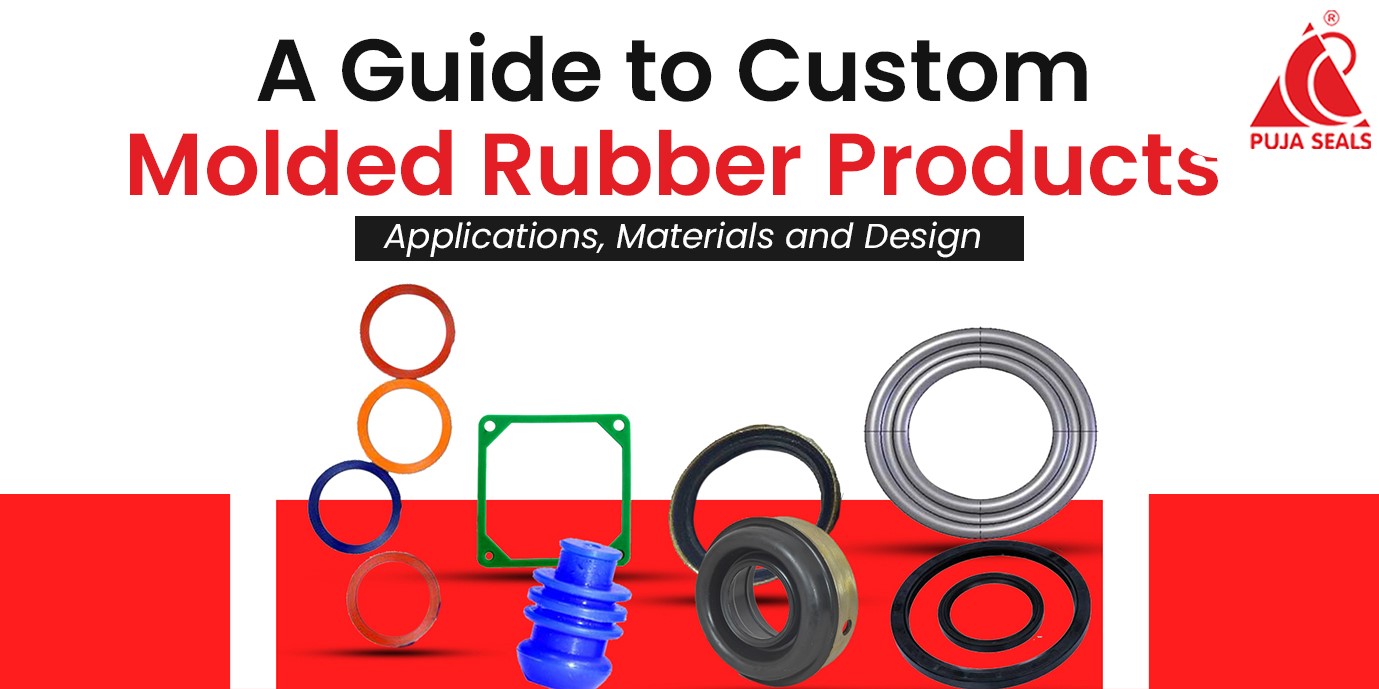
In today’s industrial scenario, Custom Molded Rubber Products are the unseen facilitators of machine reliability. As we begin 2026, the need for precision-engineered components, fueled by the EV revolution, medical advancements, and space exploration, has made the choice of these components more important than ever before.
For engineers and procurement managers, the key to minimizing machine downtime begins with understanding the life cycle of a molded component. Top-class Custom Molded Rubber Parts from a leading industrial house such as Puja Seals will ensure that your machine is always leak-tight and vibration-free in the most adverse conditions.
What Constitutes Custom Molded Rubber Products?
Custom rubber molding is the art of taking raw elastomeric material and shaping it into a desired functional form through the use of heat and pressure. As opposed to standard seals, custom rubber products are designed to satisfy precise dimensional specifications and resist precise environmental conditions. The basic components of this industry sector are:
- The Mold (Tooling): The steel or aluminum cavities that are precisely machined to create the desired part geometry.
- The Elastomer (Compound): The rubber "recipe" that is selected for its desired chemical, thermal, or mechanical characteristics.
- The Molding Process: Selecting between Injection, Compression, or Transfer molding, depending on the product volume and complexity.
- The Vulcanization: The chemical process that imparts the rubber with its desired elasticity and strength.
Step-by-Step: The Custom Molding Process Explained
To understand why specialized manufacturing is necessary, let’s break down how a custom part goes from a blueprint to a finished product.
1. Material Compounding
Not all rubber is created equal. In 2026, the industry employs sophisticated polymers formulated for a particular purpose. Whether it’s Nitril (NBR) for oil resistance or Viton (FKM) for high-temperature aerospace use, the process begins with combining the base material with curing agents and fillers.
2. Tooling and Pre-forming
The "Custom" in custom molded rubber products in pune is in the mold. With CNC machining, a manufacturer develops a tool that takes into consideration "shrinkage rates"—the tiny contraction of rubber as it cools.
3. The Molding Cycle (The "Science of Shape")
The raw rubber is loaded into the mold. Under extreme pressure and heat, the rubber fills every nook and cranny of the tool.
- Capability: Puja Seals employs the latest technology presses to guarantee even density throughout the finished part.
- Value: Accuracy during this process eliminates "flash" (excess material) and ensures that the finished part fits perfectly into its application, eliminating costly leaks.
4. Post-Curing and Finishing
After being extracted from the mold, parts can undergo "post-curing" in an oven to fully develop their chemical properties. They are then deflashed, inspected, and tested for hardness (Durometer) and tensile strength.
Why Custom Design Matters in 2026
The advent of sustainable energy and advanced robotics has set new benchmarks for molded materials.
1. Resistance to Extreme Environments
Industrial use in 2026 may include cryogenic conditions or extreme pressures. Regular rubber would not survive for an instant. Custom makers are now designing products that can "hold a seal" even when exposed to rapid decompression or strong chemical cleaners.
2. Digital Prototyping and Simulation
Even before the first cut of steel is made in a mold, the best custom molded rubber products companies rely on Finite Element Analysis (FEA). This enables designers to predict how a rubber gasket will behave under load, ensuring that the product is optimized before it is produced.
3. Bio-Compatible and Green Materials
With the increasing stringency of global regulations, there is a growing need for "Green Rubber"—materials that are made from sustainable resources or are recyclable without compromising the strength needed for industrial applications.
Key Features of a Puja Seals Custom Product
While assessing a company, it is important to make sure that they have the following 2026 standards:
- Tolerance Precision: Capable of achieving close tolerances (ISO 3302-1) for high-precision sealing applications.
- Compound Variety: Has access to a broad range of elastomers, such as Silicone, EPDM, Neoprene, and Fluorocarbons.
- Prototyping Speed: Provides "Rapid Prototyping" facilities to assist R&D departments in testing their designs in days, not weeks.
- Quality Certification: Compliant with global norms such as ISO 9001:2015 for ensuring consistency in every batch.
Why Choose Puja Seals?
As a front-runner in the sealing and molded products sector, Puja Seals offers the dependability that is necessary for engineering in the 21st century:
- Expert Engineering: We don't only manufacture, we assist you in designing the part for manufacturability (DFM) to save on costs.
- In-House Tooling: Our in-house tool room ensures that mold maintenance and modifications occur rapidly, keeping your manufacturing on track.
- Application Versatility: Ranging from mining gaskets to medical-grade O-rings, we span the entire range of applications.
- Quality Assurance: Each lot is tested stringently to ensure it complies with the required environmental and mechanical specifications.
Conclusion
Silicone Moulded Rubber Products form the foundation of industrial safety and performance. In the year 2026, there is no room for error. With Puja Seals, your components are engineered for the future, offering the strength and accuracy your projects require.
Frequently Asked Questions (FAQ)
EPDM is popular for outdoor use because of its weathering properties, while Nitrile (NBR) is the material of choice for oil-based applications. But again, the "best" material is entirely dependent on your own application.
Depending on the complexity, a custom mold can take anywhere from 1 to 4 weeks. Once the mold is made, production of individual components is very quick.
Absolutely! This is known as Rubber-to-Metal Bonding. It is a specialized process whereby rubber is molded directly onto a metal substrate, forming a permanent bond often used for engine mounts or critical valves.
Hardness is measured on the Shore A scale. A 40A is soft like a pencil eraser, while a 90A is hard like a hockey puck. Our engineers can help determine the optimal hardness based on your specific sealing pressure and environment.